Battery Management Systems: Different Types & When To Use Them

Andrew Bank
Learn more about passive and active balancing battery management systems (BMS), cell-level intelligence, and what to consider when developing a BMS.

Learn more about passive and active balancing battery management systems (BMS), cell-level intelligence, and what to consider when developing a BMS.

Batteries are the lifeblood of modern energy storage, and Battery Management Systems (BMS) help keep them safe, efficient, and ready to power everything from smartwatches to EVs to grid-scale storage.
However, not all BMS solutions are created equal. Like choosing between a Swiss Army knife and a sledgehammer, different applications require different features. Let’s dive into the world of BMS, demystify its core functionalities, and throw in some dad jokes for good measure.
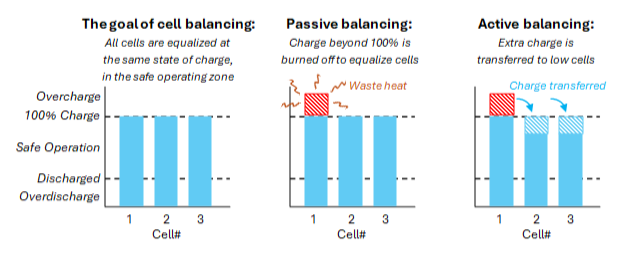
Battery management systems can be categorized as either passive or active balancing.
Passive balancing is best described as a buffet at the end of the night: if a few extra bites of food are left over at closing time, they just get thrown out. A passive balancer burns off excess energy in some cells, generating waste heat. It’s simple, reliable, and cost-effective, making it a great choice for applications where efficiency isn’t critical, like small consumer electronics or lower-cost industrial setups.
Comparatively, active balancing is more like Robin Hood in that it redistributes power (excess charge) from fuller cells to their undercharged comrades, minimizing energy loss and maximizing overall battery life. Active balancing is ideal for electric vehicles, high-end energy storage systems, and any endurance application where squeezing every last watt-hour out of a battery is crucial. Of course, active balancing is more complex and expensive, so it’s not always the go-to solution.
Cell-level monitoring provides precise data on voltage, temperature, and, in some cases, impedance for each cell. This level of oversight is crucial for:
For applications where safety, reliability, and performance are non-negotiable, investing in a BMS with cell-level intelligence is a smart move.
Selecting the appropriate BMS involves considering several factors:
Battery Management Systems are not one-size-fits-all. Understanding the nuances between passive and active balancing and when cell-level intelligence is needed can be challenging. If you don’t know the answer, and you don’t have an in-house team that knows the answer, hire external battery engineers, especially if you’re designing them for critical applications.
Treetown Tech is a product design and development company with multiple in-house capabilities, including battery engineering.
Contact us today, and let us know about your project.
You have the vision. We have the team and expertise to get it built. Let's collaborate to innovate, problem-solve, and de-risk every step of the way.